
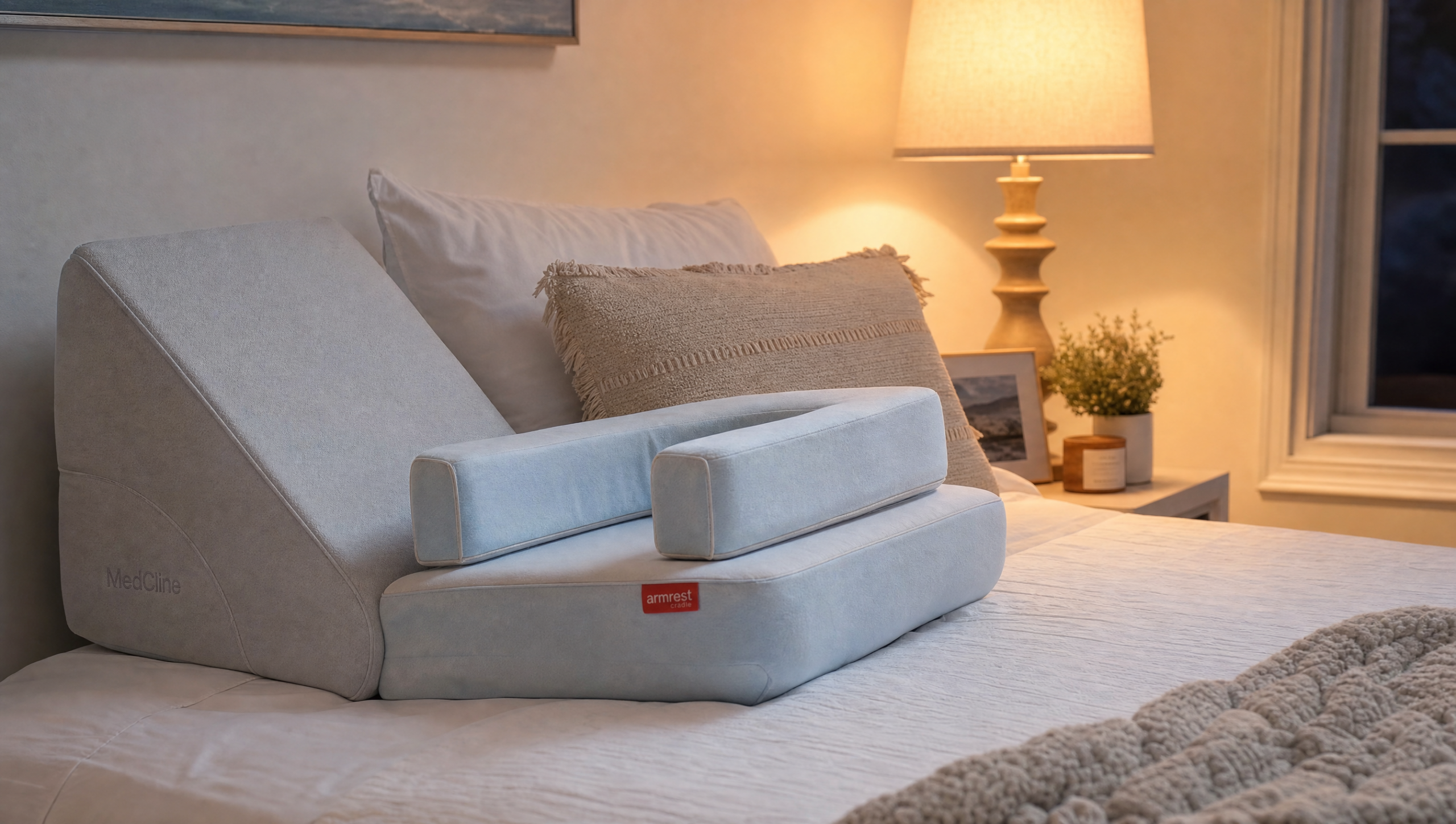
What this guide gives you that others don’t: a body-frame-to-ILD firmness chart for side sleepers post-shoulder-surgery, a clear breakdown of when to use a wedge pillow versus a compact armrest cradle, surgery-type-specific elevation protocols, and a week-by-week sleep position progression timeline. I went through rotator cuff repair myself in 2022, kept notes on what worked and what didn’t, and have since interviewed dozens of other post-op patients about the same questions. This is the guide I wish existed when I was searching for it.
What I want you to know before you start reading
PRE-SURGERY READING
Buying the pillow before surgery saves a week of sleep. The Flexicomfort Shoulder Pillow is the armrest cradle I recommend most often — fits the recovery use case without forcing you out of side-sleep alignment.
See Flexicomfort Shoulder Pillow →Most “best shoulder surgery pillow” articles online were written by people who never had shoulder surgery. They list five popular products, copy specs from Amazon, and rank them by review count.
That isn’t the article I needed in November 2022, three days before my rotator cuff repair. I needed answers to specific questions:
- What firmness fits my body — and how do I even know what firmness means in numbers?
- I sleep on my side. When can I go back to it? My surgeon said “back sleep for six weeks” — what does that look like in practice?
- A wedge or a cradle pillow — what’s the difference, and which one do I need?
- I can’t be the only side sleeper under 130 pounds — why does every recovery pillow seem designed for a 180-pound man?
Six months after my surgery I had answers. I’ve spent the last two years refining them by talking to other post-op patients — rotator cuff, shoulder replacement, labrum repairs, arthroscopies. What follows is the guide I would have given myself.
A note on what I am and am not: I’m not a doctor or a physical therapist. What I share here comes from my own recovery, customer conversations through Shoulder Surgery Pillows, and reading research on foam ergonomics and post-operative sleep positioning. Always defer to your surgeon’s specific instructions over anything you read in a blog post — including this one.
The decision you actually have to make first: wedge or armrest cradle?

Before you start comparing ILD numbers and elevation angles, you have to know which type of pillow you’re shopping for. Most guides skip this and dump both categories into one list. They are not the same product solving the same problem.
Wedge pillows (incline + back rest)
A wedge pillow elevates your upper body to a 10–45° angle. You sleep on your back, propped up, with your head and torso on the slope.
These work well for the first 1–4 weeks after most shoulder surgeries when you’re not cleared for side sleeping at all. They also help if you have post-op acid reflux (which is more common than people realize — anesthesia plus pain medication can trigger it).
The MedCline Shoulder Relief System is the dominant product in this category and the only one I know of that’s listed as an FDA Class I Medical Device. It comes paired with a body pillow that includes an arm pocket, so it bridges into category two during late recovery.
Armrest cradle pillows (focused arm + shoulder support)
An armrest cradle pillow is smaller, more focused, and built around one job: supporting the surgical arm and shoulder so they stay in a safe position while you rest.
You can use these flat against your mattress in early back-rest weeks, alongside a wedge. Later, once you’re cleared to sleep on your healthy side, the cradle supports the surgical arm so it doesn’t roll forward across your chest.
The Flexicomfort Shoulder Pillow is what I now recommend most often for the cradle role — at 22 by 15.75 inches and just under 6 inches tall, it fits the use case without being so big it forces you out of natural side-sleep alignment.
Which do you actually need?
The honest answer for most people: both, used in sequence.
- Weeks 1–4: wedge pillow as your primary, cradle pillow under your surgical arm
- Weeks 5–8: cradle pillow as primary, wedge optional for back-rest hours
- Weeks 9+: cradle pillow only, gradually phasing out
If you have to pick one, pick the one that matches your surgery type’s longest phase. Rotator cuff repair = wedge first. Arthroscopy = cradle first.
A note on the limitation of wedge pillows for side sleepers: most generic wedges are only 24 inches wide. When you roll to your healthy side, your surgical arm hangs off the edge because there isn’t enough lateral surface to support both arms in a side-sleep position. The MedCline system fixes this with its 30-inch-wide wedge plus body pillow. Cheaper wedges don’t.
ILD: the firmness measurement that decides comfort
ILD stands for Indentation Load Deflection. It’s measured against the ASTM D3574 standard, which means it’s a real number you can compare across products — when manufacturers publish it.
Here’s the practical scale:
| ILD range | Subjective feel | Best for |
|---|---|---|
| 12–22 | Soft, plush | Petite frames, healthy-side rest after week 6 |
| 22–28 | Medium-soft | Petite to slight frames, late recovery |
| 28–35 | Medium-firm | Average frames, mid-stage recovery |
| 35–42 | Firm | Average-to-broad frames, early-stage support |
| 42+ | Extra firm | Broad/heavy frames, specialized immobilization |
For context: Brentwood Home’s Zuma therapeutic wedge sits at 30 ILD with 1.8 lbs/ft³ density. That’s a useful market middle reference. Most recovery pillows from major brands cluster between 25 and 35 ILD.
A pillow without an ILD rating on its spec sheet is — bluntly — under-documented. Ask the manufacturer. If they can’t answer, the pillow is probably engineered to a price point rather than an ergonomic target.
A second number matters too: density, in pounds per cubic foot. For recovery use, 1.8 to 2.5 lbs/ft³ is the practical sweet spot. Below 1.5 lbs/ft³ the foam loses support during the night. Above 3.0 lbs/ft³ the foam responds too slowly to position changes, which gets uncomfortable when you need to shift to relieve pressure on the surgical shoulder.
The body-frame-to-ILD chart you came here for

This is the table you’d want to print. I built it from my own observations and customer conversations, then cross-checked it against manufacturer specs and ASTM ranges. It is approximate. Your shoulder size, body type, and the specific surgery matter — but the chart will get you within one ILD band of correct.
For side sleepers, post-shoulder-surgery
| Body weight | Body frame | Recommended ILD | Recommended density |
|---|---|---|---|
| Under 130 lbs | Petite | 22–26 | 1.5–1.8 lbs/ft³ |
| 130–155 lbs | Slight-to-average | 26–30 | 1.8–2.0 lbs/ft³ |
| 155–180 lbs | Average | 28–34 | 1.8–2.2 lbs/ft³ |
| 180–210 lbs | Average-to-broad | 32–38 | 2.0–2.5 lbs/ft³ |
| Over 210 lbs | Broad | 36–44 | 2.5–3.0 lbs/ft³ |
Why under-130 lbs side sleepers struggle most: the dominant recovery pillows — MedCline included — are sized and firmness-tuned for an average frame target. A petite side sleeper using a 35 ILD pillow gets pushed out of neutral shoulder alignment by foam that’s too resistant for their body weight. The shoulder rolls forward, the surgical site experiences torsion, sleep is interrupted, and morning stiffness lasts longer.
The fix: petite-frame side sleepers should target ILD 22–26 with 1.5–1.8 lbs/ft³ density. This combination supports without pushing back.
For broad frames over 210 lbs: the opposite problem. A standard 28 ILD pillow compresses too far, the shoulder descends below neutral, and the surgical site bears unnecessary load.
I want to be honest about how I built this chart: it is observational, not clinical. I watched what worked across people I talked to. I didn’t run an RCT. If you find a different range fits you better, trust your own experience over my table.
Surgery-type-specific elevation angle protocol
This is the part medical-authority sites typically gloss over with the phrase “elevate the upper body.” How much, and for how long, depends on the surgery type and on what your surgeon told you specifically.
The chart below is a generalized framework. It is not medical advice — always follow your surgeon’s specific instructions. But if your surgeon told you only “elevate” and you’re trying to figure out what that means in pillow geometry, this should narrow the gap.
Recommended elevation angles by surgery type
| Surgery | Weeks 1–2 | Weeks 3–4 | Weeks 5–6 | Weeks 7+ |
|---|---|---|---|---|
| Arthroscopy (minor) | 15–25° | 10–15° | 0–10° (return to flat as comfort allows) | Flat OK |
| Rotator cuff repair | 30–45° | 20–30° | 15–20° | 10–15° |
| Labrum (SLAP/Bankart) repair | 30–45° | 25–35° | 15–25° | 10–15° |
| Shoulder replacement (TSA) | 30–45° | 25–35° | 20–25° | 15–20° |
| Reverse shoulder replacement | 30–45° | 25–35° | 20–25° | 15–20° |
| AC joint reconstruction | 25–35° | 15–25° | 10–15° | 0–10° |
A note on MedCline specifically: their wedge has a fixed 10° incline. That works well for weeks 5+ of rotator cuff repair, and for the broader category of post-op acid reflux management. For weeks 1–4 you’ll want it propped further with additional pillows, or use it primarily for daytime back-rest while sleeping on a more aggressively-angled wedge at night.
This is where I learned the hard way that a single fixed-angle pillow is rarely the right answer for the full recovery arc. Adjustable systems — or a planned transition between two pillows at different angles — handle the timeline better.
Week-by-week sleep position progression timeline

This is the question I get asked most often and the question almost no published guide answers directly. Here’s the framework that worked for me and most people I’ve talked to.
Rotator cuff repair recovery (representative timeline)
Weeks 1–2: Reclined back rest only
- 30–45° elevation on wedge
- Surgical arm in sling, supported in armrest cradle on top of wedge
- Side sleeping forbidden, even on healthy side
- This phase felt the longest. It wasn’t.
Weeks 3–4: Reclined back rest, brief healthy-side trials
- 20–30° elevation
- 10–15 minute healthy-side rests allowed, with the cradle pillow across your chest holding your surgical arm steady
- No surgical-side rest yet
Weeks 5–6: Reduced elevation, healthy-side rest extended
- 15–20° elevation
- Healthy-side rest up to 1–2 hours acceptable
- Surgical-side rest still avoided
- I started getting actual sleep in this window. Up to that point it was hours of half-sleep, not real rest.
Weeks 7–8: Light surgical-side sleeping introduced
- 10–15° elevation
- Surgical-side rest 15–30 minutes with the armrest cradle supporting the shoulder
- Most patients return to side sleeping comfortably by week 8–10
Weeks 9–12: Return to baseline
- 0–10° elevation as comfort allows
- Either side, with armrest cushion still recommended for surgical-side rest
- I went back to my normal pillow setup at week 11
For shoulder replacement and labrum repairs, add 2–3 weeks to each phase. For arthroscopy, subtract 1–2 weeks. Your surgeon’s instructions override this framework.
Pillow rotation strategy: surgical-side vs healthy-side
For focused arm + shoulder cradle
Lightweight compact form. Works with whatever wedge you choose. Fits petite-to-broad frame range.
See Flexicomfort Shoulder Pillow → our product
This is the piece almost nobody talks about, and the piece that made the biggest difference for me by week 6.
Once you’re cleared for side sleeping (typically week 5–6 onwards), the question isn’t just “which side?” — it’s “how do you distribute the load across both?”
The rotation principle
If you sleep eight hours and spend all of them on one side, even the healthy-side shoulder accumulates pressure. The surgical-side meanwhile gets no graduated reintroduction. Both outcomes slow recovery in their own way.
A practical rotation pattern (weeks 6+)
- First 4 hours: healthy side, with the cradle pillow supporting the surgical arm across your chest
- Light shift to back rest 15–30 minutes (gives both shoulders pressure relief)
- Final 3–4 hours: surgical side with cradle pillow under your surgical arm, lower elevation
This keeps both shoulders engaged in gentle distributed load while avoiding single-side overload. If you wake to shift naturally, you’re doing it right. If you sleep through the night without shifting, your pillow may be too soft — you’re sinking too far in and not feeling pressure points that would normally trigger a position change.
The cradle pillow makes this rotation actually work. Without one, your surgical arm will roll forward across your chest the moment you turn to the surgical side, undoing whatever healing progress you’ve made that day.
Five leading shoulder recovery pillows: verified comparison
For wedge incline support
If you fit the average frame and want the FDA-listed option, the MedCline system is the strongest default.
Check MedCline on Amazon → affiliate linkThis is where most guides start. I’ve put it here on purpose — the protocol and the chart matter more than which specific product you buy. With that said, here are the five most-used options compared on the dimensions that matter.
Wedge pillow category
| Product | Wedge angle | Dimensions | Foam | Density | ILD | Best for |
|---|---|---|---|---|---|---|
| MedCline Shoulder Relief System | 10° (fixed) | 6″H × 30″W × 31–34″L | HD polyethylene + gel-infused memory foam (body pillow) | Not published | Not published | FDA Class I device; average frame, rotator cuff, acid reflux + post-op combo |
| Brentwood Home Zuma Therapeutic | Fixed (7″, 10″, 12″ heights) | 7–12″H, standard width | BioFoam® (CertiPUR-US) | 1.8 lbs/ft³ | 30 ILD | Average frame, late-stage back rest |
| Generic 24″ wedge (multiple brands) | Variable 10–18° | 24″W typical | Polyurethane foam | 1.5–2.0 lbs/ft³ | 25–35 ILD typical | Budget option; too narrow for side sleeper transition |
Armrest cradle pillow category
| Product | Dimensions | Foam | Weight | Best for |
|---|---|---|---|---|
| Flexicomfort Shoulder Pillow | 22″L × 15.75″D × 5.9″H | Memory foam | ~2 lbs | Compact armrest support; side sleeper transition; petite-to-broad frame fit |
| AbleUplift Rotator Cuff Pillow | Variable (adjustable) | Multi-layer foam | Mid-range | Adjustable support; broader frame fit |
| Cheer Collection W-shape | Standard | Hollow fiber fill | Light | Budget option; less firm support |
Practical takeaway from someone who’s used several of these: you don’t need the most expensive option. You need the right firmness for your body frame, the right form factor for your recovery week, and ideally one wedge pillow plus one cradle pillow used in sequence. A $400 MedCline system is a strong default if you fit the average frame target. A $40 wedge plus a $35 Flexicomfort cradle will cover the same recovery arc for a fraction of the cost if you’re price-sensitive — but check the ILD ratings before you buy.
I’ll be transparent: I’m affiliated with the Flexicomfort line. I recommend it because I’ve seen it work, and because the form factor matches the recovery use case I needed when I was looking. There are other good options. If you’re petite or broad-framed and the standard sizes don’t fit your situation, message me — I’d rather you buy the right pillow elsewhere than the wrong pillow here.
Petite frame (under 130 lbs) specific considerations
This is the part I get the most questions about, and the part most product reviews quietly skip. Most leading recovery pillows assume an average frame target. If you weigh under 130 lbs, here’s what changes:
- Lower ILD is mandatory — target 22–26. Higher firmness pushes you out of neutral shoulder alignment.
- Lower elevation angle works fine — an 8–10° wedge gives the same effective shoulder unload as a 12° wedge does for a 170 lb user, because your body weight contributes less pressure to begin with.
- Cradle armrest sizing matters more — a cradle designed for a broader arm leaves your surgical arm unsupported in the cutout. Look for stated cradle dimensions, or contact the manufacturer.
- Cover material against the skin is more sensitive — petite users often report more skin irritation from polyester covers during recovery. Cotton, bamboo viscose, or viscose-blend covers are preferable.
The petite-frame group is genuinely underserved in this category. A 110 lb post-rotator-cuff patient using a generic 32 ILD pillow is mismatched in a way that the pillow’s own customer reviews can’t surface — they just feel “uncomfortable” and don’t know why. If you’ve been one of those people, this is what’s going on.
Common mistakes (and what to do instead)
Mistake 1: Going by elevation height in inches rather than degrees. A 7-inch wedge can be 10° or 18° depending on base width. Always confirm the angle — it’s what biomechanically matters.
Mistake 2: Using a soft pillow because “recovery is when you need comfort.” The opposite is closer to true. A pillow too soft for your body frame collapses under your shoulder, increases pressure, and slows recovery. Comfort comes from correct support, not soft material.
Mistake 3: Sleeping flat on the surgical-side before week 5–6. This is reasonable to want — that’s your habit. But the surgical site needs gradual loading, not immediate. Follow the week-by-week protocol or your surgeon’s specific schedule.
Mistake 4: Skipping the cradle armrest because “the sling holds my arm.” The sling holds your arm during the day. At night, with muscle relaxation, the surgical arm rolls forward without active support. A cradle armrest matters even with a sling.
Mistake 5: Buying the cheapest acceptable option to “test if it works.” A pillow that almost-fits wastes 6–8 weeks of recovery time, and you’ll end up buying a second one anyway. Buy correct the first time.
Mistake 6 (my own, in case it helps): I assumed I could “tough it out” with a stack of regular pillows during weeks 1–2. I lost a week of sleep before I bought a wedge. If you’re reading this before surgery: get the pillow before you need it.
What I learned interviewing other post-op patients
Across the conversations I’ve had over the past two years, three patterns kept showing up:
- The patients who recovered most comfortably tracked their pillow setup against their week. Notes in a journal: “week 4, used 15° angle, cradle on, slept 6 hours straight.” They became their own data source. By week 8 they’d figured out what worked specifically for their frame and surgery.
- The patients who struggled most owned a pillow that almost-fit. Slightly too firm, slightly too low an angle, cradle slightly too wide. Almost-fit pillows let you sleep — but the surgical site never gets the load relief it needs to heal optimally.
- The patients who recovered fastest used a multi-pillow setup, not a single all-in-one product. They had the wedge for elevation, a cradle for the surgical arm specifically, and a small lumbar pillow for back support during back-rest hours. Three small purposeful supports outperformed one large hybrid pillow.
If you take one thing from this guide, take this: the right firmness for your body frame, the right angle for your surgery week, and a planned transition through recovery stages — that combination beats any single “best pillow” choice.
Frequently asked questions
How do I find the ILD of a pillow I already own?
Most spec sheets list it under “firmness specifications” or “foam properties.” If absent, contact the manufacturer with the product SKU and ask. If they can’t answer within two business days, the pillow likely was not engineered to a specific ILD target — which is itself diagnostic.
Can I use a regular wedge pillow for post-shoulder-surgery?
For arthroscopy week 4 and onwards — yes, if it provides the right angle for your week. For rotator cuff, replacement, or labrum repair in the early weeks — typically not, because regular wedges lack armrest cradles and the firmness is rarely matched to recovery-specific load needs.
How long do I need a recovery pillow?
Most rotator cuff repair patients use a recovery pillow setup for 8–12 weeks. Shoulder replacement: 12–16 weeks. Arthroscopy: 4–6 weeks. After that the pillow becomes optional for comfort.
What about side sleeping with frozen shoulder (not surgery)?
Frozen shoulder pre-treatment and post-manipulation share many comfort considerations with post-surgical recovery. The protocols above apply with modifications — typically lower elevation angles and shorter recovery timeline.
Is MedCline actually FDA approved?
MedCline’s Shoulder Relief System is registered as an FDA Class I Medical Device. This is the lowest medical device class — it doesn’t mean clinically proven, but it does mean the company submitted device documentation to the FDA. Class I means low-risk and exempt from most pre-market controls. The 95% sleep-improvement number that MedCline cites comes from their own user survey, not from a peer-reviewed clinical trial. I bring this up because the FDA designation is a real differentiator from generic wedge pillows, but it’s not the same as having clinical proof of effectiveness.
Next steps
- Identify your body frame band from the chart above
- Note your week of recovery and your surgery type
- Match the recommended ILD, density, and elevation angle to what’s available
- Decide: do you need a wedge, a cradle, or both?
- Choose products that cover your full recovery arc, not just week 1
If you have a specific question about your situation that this guide didn’t answer, send me a note. I read everything that comes in and try to point people to whatever fits their case best — even when that’s not one of our products.
Sources
- ILD measurement methodology — ASTM D3574 standard via TestResources ASTM D3574, Indentation Force Deflection Testing, SleepOnLatex: What is ILD?
- MedCline Shoulder Relief System specs — MedCline Shoulder Pain Relief System, Mattress Clarity MedCline review, Performance Health MedCline
- Brentwood Home Zuma Therapeutic Wedge specs — Brentwood Home Zuma
- Wedge vs cradle category analysis — Surgical Recovery Systems best wedge pillow guide, Surgical Recovery Systems best pillow 2026 guide
- Post-op sleep position recommendations — Sleep Foundation: Best Pillows for Shoulder Pain, Sleep Again Pillows: Sleeping After Shoulder Surgery
- Personal observations — author’s rotator cuff repair recovery (2022) and customer conversations through Shoulder Surgery Pillows (2022–2026)
Ready to plan your recovery setup?
Start with the body-frame chart, your surgery type, and which week of recovery you’re entering. A wedge plus a cradle pillow covers the full arc.
Flexicomfort Shoulder Pillow MedCline System
About the author
James Park is a sleep ergonomics writer and post-rotator-cuff-repair recovery patient. He underwent rotator cuff repair in November 2022 and spent the following six months tracking what worked and what didn’t in his own recovery. Since then he has worked with the Shoulder Surgery Pillows team, talking to dozens of other post-op patients to refine the protocols described above.
James is not a medical professional and the content here is not medical advice. He writes from lived experience and observational research. Always defer to your surgeon’s specific instructions over anything you read here.
You can reach James at [contact form] for specific recovery questions.
Affiliate disclosure
Shoulder Surgery Pillows participates in the Amazon Services LLC Associates Program, an affiliate advertising program designed to provide a means for sites to earn fees by linking to Amazon.com. Some links on this page are affiliate links — if you buy through them we earn a small commission at no additional cost to you. This does not affect which products we recommend or how we describe them. Products covered by affiliate relationships are noted; products without affiliate relationships are still covered when relevant.