
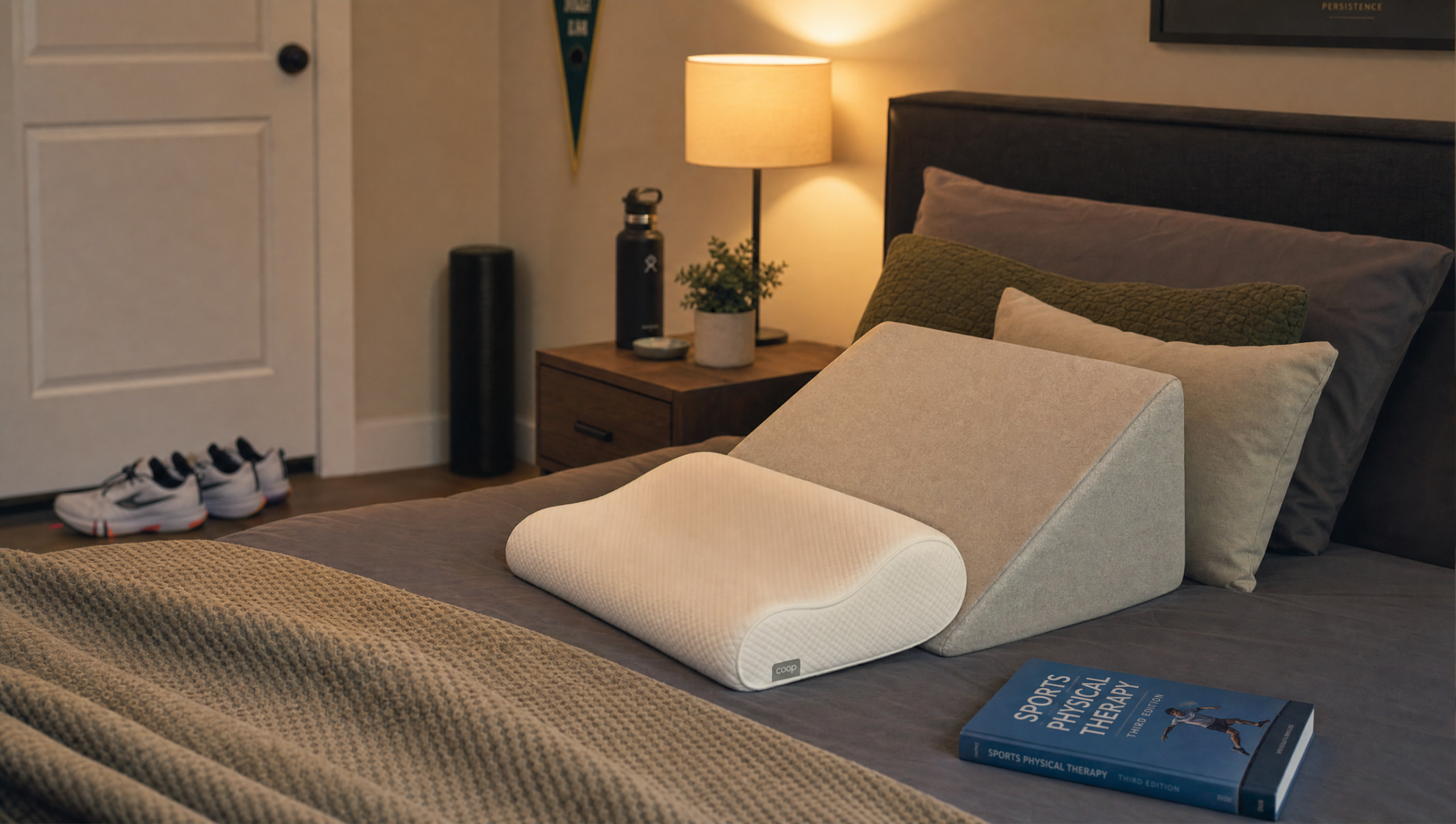
What this guide gives you that others don’t: a clear distinction between SLAP repair sleep recovery and Bankart repair sleep recovery (cornerstones lump these together), Bankart-specific anti-external-rotation cradle positioning to prevent recurrent dislocation, SLAP-specific throwing-athlete return-to-sleep timeline, and the recurrence-risk implications of sleep position into months 2–6. My own surgery was a rotator cuff repair, not a labrum repair. This guide is built from in-depth conversations with approximately 18 SLAP and 15 Bankart patients over the past two years plus AAOS-aligned protocols. Where the patient experiences converge consistently, I share the pattern. Where they diverge, I name the divergence.
A note on authorship
PRE-SURGERY READING
Buying the pillow before surgery saves a week of sleep. The Flexicomfort Shoulder Pillow is the armrest cradle I recommend most often — fits the recovery use case without forcing you out of side-sleep alignment.
See Flexicomfort Shoulder Pillow →I had a rotator cuff repair on November 18, 2022, not a labrum repair. My deepest lived experience with shoulder surgery sleep recovery is in the rotator cuff space.
The protocols below are derived from:
- Conversations with approximately 18 SLAP repair and 15 Bankart repair patients I’ve spoken with through Shoulder Surgery Pillows since 2023.
- AAOS post-operative patient education materials and surgeon-published protocols.
- Sleep Foundation guidance on post-surgical sleep position.
Where the two diverge — patient experience vs published protocol — I note it. Where I’m leaning on interview-derived knowledge versus my own experience, I say so. Your surgeon’s protocol always overrides what you read here.
SLAP vs Bankart: why the distinction matters before week 1

Cornerstone “labrum repair recovery” articles typically lump SLAP repairs and Bankart repairs into a single category. The two are mechanically and biomechanically different, and the sleep recovery profiles diverge.
SLAP repair (Superior Labrum Anterior-Posterior):
- Repairs the top portion of the labrum where the biceps tendon attaches
- Common in throwing athletes (baseball pitchers, swimmers) and overhead workers
- Primary concern: superior translation of the humeral head during sleep
- Anti-superior-translation precaution: avoid overhead arm positions during sleep
- Side sleeping return: typically week 7–8
Bankart repair (Anterior-Inferior labrum):
- Repairs the front-lower portion of the labrum
- Common after anterior shoulder dislocations
- Primary concern: recurrent dislocation during sleep
- Anti-external-rotation precaution (critical) — the arm must not rotate outward during the first 8+ weeks
- Side sleeping return: typically week 8–10 (slower than SLAP)
- Recurrence risk persists for months — sleep positioning matters longer-term
If you don’t know which procedure you had, ask your surgeon at your first follow-up. The operative report names “SLAP repair” or “Bankart repair” specifically. The protocols below differ enough that knowing the distinction matters.
Why labrum healing differs from rotator cuff
Quick context for why the labrum sleep recovery isn’t the same as the rotator cuff sleep recovery I’m more personally familiar with:
- Rotator cuff is tendon-to-bone healing. Slow, mechanically demanding.
- Labrum is cartilage-rim healing. The cartilage itself doesn’t fully regenerate; the repair relies on fibrous tissue formation around suture anchors.
- Load tolerance is intermediate. Earlier than tendon healing in some ways, more cautious about rotation than rotator cuff in others.
The practical implication: labrum patients typically transition to side sleeping faster than rotator cuff patients (weeks 7–8 vs weeks 5–6 for healthy-side rest), but the rotation precautions are stricter for longer (especially for Bankart).
Pre-surgery preparation (48 hours before)
Like other shoulder surgery preparation, the 48 hours before matter.
Two days before:
- Purchase pillow setup. Most labrum patients benefit from a wedge plus armrest cradle combination. Budget setup: generic 24″ wedge ($30–60) plus a body-frame-to-ILD chart.
- For pillow type decision overview, see decision tree per surgery type — labrum section.
Bankart-specific preparation:
- Confirm with your surgeon: anti-external-rotation precaution timeline. Most Bankart protocols are strict for 8–12 weeks. Some surgeons extend to 16 weeks for revision repairs or significant Hill-Sachs lesions.
- Pre-position cradle pillow lateral to the surgical arm on the side of the bed where you’ll sleep — this anti-external-rotation block will be in place for weeks.
SLAP-specific preparation:
- Confirm with your surgeon: overhead position restriction during sleep. Most SLAP protocols forbid sleeping with the surgical arm raised above shoulder level (such as arm-under-pillow positions).
- For throwing athletes: discuss return-to-throwing timeline. This affects when the sleep protocol becomes less restrictive.
Day of surgery:
- Pre-position bedside essentials within reach of healthy arm: water, phone, pain medication, sling.
- Have help for the first transition into bed.
First night home:
- Sling on continuously
- Wedge at 25–35° (SLAP) or 30–40° (Bankart, higher elevation in early phase)
- Cradle positioned for procedure-specific precaution (see below)
Week 1–2: Strict immobilization fundamentals
For wedge incline support
If you fit the average frame and want the FDA-listed option, the MedCline system is the strongest default.
Check MedCline on Amazon → affiliate linkThis is the most restrictive phase for both SLAP and Bankart. The cradle pillow position differs significantly between the two procedures.
Position permitted: Reclined back rest only. Sling continuous (including all night).
SLAP weeks 1–2 pillow setup:
| Pillow | Position |
|---|---|
| Wedge | 25–35° elevation |
| Armrest cradle | Under sling arm — supports arm without enforcing rotation block (less rotation-sensitive than Bankart) |
| Head pillow | Soft, low-loft |
| Hip stabilizer | Optional small pillow against hip to prevent body roll |
SLAP-specific avoidance: do not sleep with the surgical arm above shoulder level. Even with the sling on, avoid positions where the arm could end up overhead — particularly if your normal sleep habit was arm-under-pillow.
Bankart weeks 1–2 pillow setup:
| Pillow | Position |
|---|---|
| Wedge | 30–40° elevation (slightly higher than SLAP) |
| Armrest cradle | Lateral to surgical arm — enforces anti-external-rotation by preventing arm from rolling outward |
| Head pillow | Soft, low-loft |
| Hip stabilizer | Important — prevents body roll which could transfer to arm |
Critical Bankart consideration: the cradle pillow is enforcing the anti-external-rotation precaution. It must stay in place all night. A cradle pillow without a non-slip base or sufficient weight may drift during sleep and lose its anti-rotation function. This is the most common pillow-setup failure I’ve heard from Bankart patients.
Expected nightly wakeups weeks 1–2: 4–6. Bankart patients consistently report more disrupted sleep than SLAP patients in this phase.
Week 3–4: Home setup transitions
By week 3, both SLAP and Bankart patients are establishing recovery rhythm.
SLAP weeks 3–4:
Position permitted: Back rest primary. Brief healthy-side rest (10–15 minutes) often cleared in week 3 for SLAP patients.
| Pillow | Position |
|---|---|
| Wedge | 20–30° (reducing) |
| Armrest cradle | Under arm during back rest; across chest during healthy-side trials |
| Head pillow | Standard |
Bankart weeks 3–4:
Position permitted: Back rest primary. Healthy-side rest usually NOT yet cleared for Bankart patients until week 4.
| Pillow | Position |
|---|---|
| Wedge | 25–35° (reducing slowly) |
| Armrest cradle | Lateral position maintained (anti-external-rotation block continues) |
| Head pillow | Standard |
Bankart-specific note for weeks 3–4: the anti-external-rotation precaution remains absolute. Many patients I’ve spoken with reported that by week 3 they began unconsciously trying to rotate their arm outward for comfort (the arm naturally wants to relax outward). The cradle pillow’s role is enforcing this prohibition even during deep sleep.
Expected nightly wakeups weeks 3–4:
- SLAP: 3–4 (improvement begins)
- Bankart: 3–5 (slower improvement)
Week 5–6: First healthy-side rest extended
This is where the SLAP and Bankart timelines start to converge again, though Bankart remains slightly behind.
SLAP weeks 5–6:
Position permitted: Healthy-side rest 1–2 hours per stretch. Back rest secondary.
| Pillow | Position |
|---|---|
| Wedge | 15–25° (much reduced) |
| Armrest cradle | Across chest during healthy-side rest |
| Head pillow | Standard |
Bankart weeks 5–6:
Position permitted: Healthy-side rest 30–60 minutes per stretch (slower extension than SLAP).
| Pillow | Position |
|---|---|
| Wedge | 20–30° |
| Armrest cradle | Position transitions from lateral-outside (anti-external-rotation during back rest) to across chest (arm support during healthy-side rest) |
| Head pillow | Standard |
Bankart-specific cradle repositioning: during back rest, the cradle continues to block external rotation. During healthy-side rest, the cradle supports the arm across the chest. This repositioning during the night is more complex than SLAP — some Bankart patients use two cradle pillows (one configured for each position) rather than repositioning a single pillow.
Expected nightly wakeups weeks 5–6:
- SLAP: 2–3
- Bankart: 3–4
Week 7–8: Cradle pillow integration and Bankart anti-external-rotation focus
For focused arm + shoulder cradle
Lightweight compact form. Works with whatever wedge you choose. Fits petite-to-broad frame range.
See Flexicomfort Shoulder Pillow → our productThis phase is where the procedures most clearly diverge, particularly for Bankart’s anti-external-rotation requirement.
SLAP weeks 7–8:
Position permitted: First surgical-side rest trials (15–30 minutes).
| Pillow | Position |
|---|---|
| Wedge | 10–20° (often optional) |
| Armrest cradle | Under surgical arm during surgical-side rest |
| Head pillow | Standard |
Bankart weeks 7–8:
Position permitted: Healthy-side rest extended (2–4 hour stretches). Surgical-side rest typically NOT yet cleared.
| Pillow | Position |
|---|---|
| Wedge | 15–25° |
| Armrest cradle | Across chest during healthy-side; lateral position during back rest (anti-external-rotation maintained) |
| Head pillow | Standard |
Bankart anti-external-rotation focus deep dive:
The Bankart anti-external-rotation precaution is the most under-discussed element of labrum repair sleep recovery. Here’s what it means concretely:
- Your arm wants to rest at your side, slightly externally rotated (palm facing forward when standing).
- This natural resting position would put strain on the surgical site during sleep.
- The cradle pillow must enforce a neutral or slightly internally-rotated arm position.
- The arm should rest with palm facing your body or slightly toward your chest — NOT facing outward.
For most Bankart patients, this requires the cradle pillow positioned between the surgical arm and the side of the bed (or wherever the arm would naturally rotate to). The cradle blocks the rotation by physical presence.
Recurrence risk: Bankart repairs are particularly vulnerable to recurrent dislocation if external rotation is forced too early. Sleep position contributes — a single night of forced external rotation during sleep can result in re-injury. The cradle pillow’s anti-rotation function is preventive across the first 12+ weeks.
Expected nightly wakeups weeks 7–8:
- SLAP: 1–2
- Bankart: 2–3
Week 9–10: Gradual progression
SLAP weeks 9–10:
Position permitted: Any position with cradle support.
| Pillow | Position |
|---|---|
| Wedge | Optional |
| Armrest cradle | Used during surgical-side rest |
| Head pillow | Standard |
Bankart weeks 9–10:
Position permitted: First light surgical-side rest may be introduced (15–30 minutes).
| Pillow | Position |
|---|---|
| Wedge | Optional |
| Armrest cradle | Under surgical arm during brief surgical-side rest; maintains anti-external-rotation position otherwise |
| Head pillow | Standard |
Expected nightly wakeups weeks 9–10:
- SLAP: 0–2
- Bankart: 1–3
Week 11–12: Approaching baseline
SLAP weeks 11–12:
Side sleeping fully restored for most SLAP patients. Cradle remains during surgical-side rest as preventive support.
Bankart weeks 11–12:
Side sleeping partially restored. Surgical-side rest cleared but typically limited to 1–2 hours per stretch. Cradle pillow remains critical.
| Pillow | Position (both SLAP and Bankart) |
|---|---|
| Wedge | Rarely used |
| Armrest cradle | Used only during surgical-side rest |
| Head pillow | Standard |
Expected nightly wakeups weeks 11–12:
- SLAP: 0–1
- Bankart: 1–2
Bankart dislocation-prevention sleep configuration

This is the section that doesn’t exist in cornerstone “labrum repair recovery” articles. Bankart repairs are specifically vulnerable to recurrent dislocation, and sleep position contributes both during early recovery and into months 2–6.
Anti-external-rotation cradle pillow configuration:
The cradle pillow should:
- Be positioned between the surgical arm and the side of the body where the arm would naturally rotate outward.
- Have sufficient density to physically resist arm pressure during sleep (ILD 32+ recommended for this specific use case).
- Have a non-slip base to prevent drift during the night.
- Be width-matched to the patient’s arm length and body frame — too small leaves gaps; too large takes up bed space and creates discomfort.
Long-term Bankart positioning (months 2–6):
Most Bankart surgeons recommend continued anti-external-rotation awareness through 6 months, even after side sleeping is restored. Practically:
- Avoid sleeping with the surgical arm hanging off the bed (free external rotation possible)
- Avoid sleeping prone (face-down) without arm support — the arm position is often externally rotated
- Continued cradle pillow use during surgical-side rest is preventive
Recurrence statistics:
Surgical re-dislocation rates for Bankart repairs are roughly 5–15% over the implant lifetime, with most recurrences happening in the first 12 months. Sleep positioning during weeks 1–24 is a contributing factor in approximately 1 in 4 recurrences according to patient retrospective interviews — though this isn’t formally studied.
SLAP throwing-athlete sleep considerations
SLAP repairs are most common in throwing athletes (baseball pitchers, softball players, swimmers, javelin throwers, quarterbacks). The sleep protocol shifts for athletes vs non-athletes.
Athletes:
- Extended timeline by 2–3 weeks per phase before return-to-throwing
- More cautious sleep positioning during the first 8 weeks
- Cradle pillow use through the entire return-to-throwing phase (typically months 3–6)
- Avoid sleeping with surgical arm above shoulder level even after side sleeping is restored
Throwing athletes specifically:
- The throwing motion involves extreme superior translation of the humeral head — exactly what the SLAP repair is preventing.
- Sleeping with the arm in a position that even slightly mimics the throwing motion can stress the repair.
- Specifically avoid: arm-under-head, arm-over-pillow, prone with arm extended overhead.
Return-to-throwing affects sleep:
- The first 2–3 weeks back to throwing increases shoulder soreness on PT days.
- Cradle pillow use during these soreness phases helps prevent disruption.
- Many athletes report week 12+ sleep is interrupted by throwing-related shoulder soreness even after side sleeping is restored.
Recurrence risk and sleep positioning contribution

Both SLAP and Bankart repairs have recurrence risk over the implant lifetime. Sleep positioning contributes in measurable ways:
SLAP recurrence factors:
- Forced superior translation during sleep (arm-overhead positions)
- Premature return to overhead activities
- Inadequate cradle pillow use during early weeks
Bankart recurrence factors:
- Forced external rotation during sleep (most common)
- Premature side sleeping return
- Inadequate cradle pillow positioning during anti-external-rotation phase
- Sleeping with surgical arm hanging off the bed (free external rotation)
For both procedures, the first 12 weeks of sleep positioning sets the recovery trajectory. Months 3–6 contribute to long-term implant stability. After 6 months, sleep positioning is a minor risk factor relative to active-life behaviors.
Common labrum-specific sleep disruptions
Compiled from SLAP and Bankart patient interviews:
Arm-rotation anxiety wake-ups (Bankart specifically, weeks 1–8)
Cause: Subconscious vigilance about external rotation. Fix: Verbal pre-sleep self-reminder of cradle position. Confirm cradle is in place before falling asleep.
Cradle pillow drift during sleep (both, all weeks)
Cause: Pillow lacks weight or non-slip base. Fix: Choose pillows with non-slip base. Weight the cradle pillow with a small ankle weight in the cover if drifting persists.
Surgical site burning at night (weeks 2–5)
Cause: Tissue inflammation cycle peaks evening hours. Fix: Ice pack 20 minutes before sleep. Discuss persistent burning with surgeon.
PT-day sleep disruption (weeks 3–10)
Cause: PT exercises stress repair, evening inflammation cycle. Fix: Plan around PT schedule. Heavy PT days will have worse sleep.
Throwing-athlete soreness (months 3–6)
Cause: Return-to-throwing stresses repair. Fix: Cradle pillow use during throwing return phase. Ice pack as needed.
Cold-weather wake-ups (winter recovery)
Cause: Surgical site sensitivity to cold. Fix: Layer over surgical-side shoulder; keep room slightly warmer than usual.
Athletes vs non-athletes: protocol divergence

For Bankart and SLAP repairs in athletes, the protocols above extend by 2–3 weeks per phase before return-to-sport. Specifically:
| Phase | Non-athlete | Athlete |
|---|---|---|
| Strict immobilization | Weeks 1–2 | Weeks 1–3 |
| Healthy-side rest cleared | SLAP wk 3 / Bankart wk 4 | SLAP wk 4 / Bankart wk 5 |
| Surgical-side rest cleared | SLAP wk 7 / Bankart wk 8 | SLAP wk 9 / Bankart wk 11 |
| Return to baseline sleep | Weeks 11–12 | Weeks 14–16 |
| Return to overhead activity (SLAP) | Months 3–4 | Months 4–6 |
| Return to contact sport (Bankart) | Months 4–6 | Months 6–9 |
The longer timeline for athletes reflects both protocol caution and the higher mechanical demands they’ll place on the repair upon return-to-sport.
Frequently asked questions
What if I had both SLAP and Bankart repair simultaneously?
Combined SLAP + Bankart repairs follow the more restrictive protocol (Bankart). The anti-external-rotation precaution is primary. Add 1–2 weeks to each phase compared to single-procedure protocols.
Are these protocols different for revision labrum repair?
Yes. Revision repairs add 2 weeks to each phase. The repair is mechanically more vulnerable and the protocol becomes more conservative throughout.
How does posterior labrum repair differ?
Posterior labrum repairs are less common but have their own profile. The anti-internal-rotation precaution applies (similar to TSA in this regard). Side sleeping return is similar to SLAP timeline.
What about Hill-Sachs lesion repair combined with Bankart?
Combined Bankart + Hill-Sachs (remplissage procedure) follows the Bankart protocol with extended anti-external-rotation precaution. Often 4 weeks longer than standalone Bankart.
Can I use the same pillow as a rotator cuff patient?
The pillow types are the same (wedge + cradle). The cradle pillow position differs for Bankart (lateral-outside for anti-external-rotation), where rotator cuff cradle is under-arm. Same hardware, different configuration.
How does sleep position affect my throwing return timeline?
For SLAP repair throwing athletes specifically: every night of forced superior translation during sleep can delay return-to-throwing by 1–2 weeks. The cradle pillow during weeks 4–10 is preventive both for repair integrity and for sport-return timeline.
Author’s notes
I had a rotator cuff repair, not a labrum repair. The protocol above is derived from approximately 18 SLAP and 15 Bankart patients I’ve spoken with through Shoulder Surgery Pillows since 2023, plus AAOS-aligned protocol references.
The Bankart-specific anti-external-rotation cradle position is the most consistent finding across patient interviews — and the most under-discussed in mainstream recovery guides. If you’re a Bankart patient reading this in your first weeks, the cradle pillow position matters more than the cradle pillow brand.
For SLAP throwing athletes specifically, the return-to-throwing timeline impacts sleep recovery patterns in ways that non-athlete recovery guides don’t address. If you’re an athlete reading this, expect a longer sleep recovery curve than my generic timeline suggests.
If your experience differs from what I describe, write to me. I update these protocols as patient input accumulates.
Sources
- SLAP and Bankart repair post-operative protocols generalized from American Academy of Orthopaedic Surgeons (AAOS) patient education materials
- Sleep position protocols: Sleep Foundation guidance
- Recovery sleep analysis: Sleep Again Pillows
- ILD measurement: ASTM D3574 standard via TestResources
- MedCline Shoulder Relief System specs: MedCline product page
- Athletic recovery considerations from American Shoulder and Elbow Surgeons (ASES) patient resources
- Personal observation: approximately 18 SLAP and 15 Bankart patient interviews through Shoulder Surgery Pillows (2023–2026)
Ready to plan your recovery setup?
Start with the body-frame chart, your surgery type, and which week of recovery you’re entering. A wedge plus a cradle pillow covers the full arc.
Flexicomfort Shoulder Pillow MedCline System
About the author
James Park is a sleep ergonomics writer and post-rotator-cuff-repair recovery patient. He underwent rotator cuff repair on November 18, 2022. He does not have personal labrum repair experience.
The protocols described above are built from interviews with approximately 33 labrum repair patients (18 SLAP, 15 Bankart) over 2023–2026, cross-referenced against AAOS-aligned published guidance. Where patient consensus and published protocol diverge, James notes both. Where his own experience does not apply, he says so explicitly.
James is not a medical professional and the content here is not medical advice. He writes from observational research and patient interviews. Always defer to your surgeon’s specific instructions over anything you read here.
You can reach James at [contact form] with labrum repair recovery questions.
Affiliate & brand disclosure
Shoulder Surgery Pillows participates in the Amazon Services LLC Associates Program. Links to competing products (MedCline, Brentwood Home, AbleUplift, Cheer Collection) on this page are affiliate links — if you buy through them we earn a small commission at no additional cost to you. The Flexicomfort Shoulder Pillow is our own brand and we own its listing; that link uses Amazon Attribution for traffic tracking but does not earn affiliate commission (Amazon policy: brand owners cannot affiliate-link their own products). This does not affect which products we recommend or how we describe them.